Ilion High School - Class of 1885Ilion Citizen - July 3, 1885Ilion AcademyArticle 1Source pdf file is here Illion NY Citizen 1880-1885 - 0024.pdf on fultonhistory.com
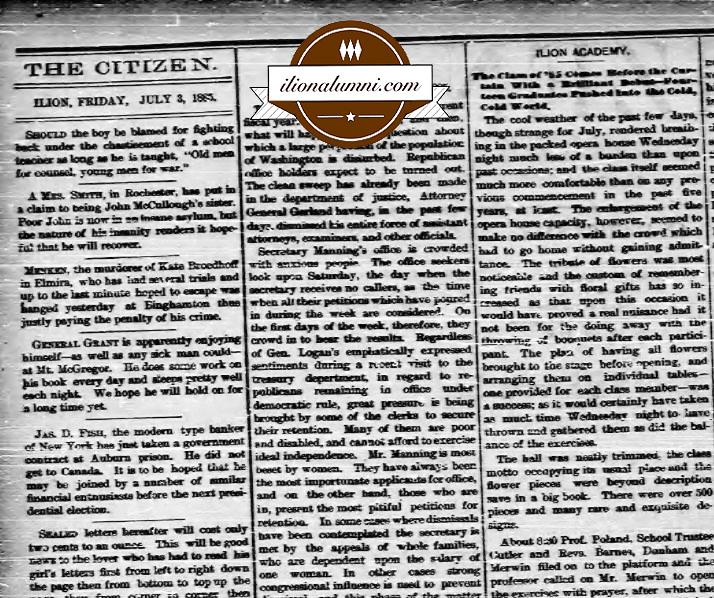
The Class of '85 Comes before the Curtain With a Brilliant Debut - Fourteen Graduates Pushed into the Cold, Cold World. The cool weather of the past few days tough strange for July, rendered breathing in the packed opera hose Wednesday night mush less of a burden than upon past occasions; and the class itself seemed much more comfortable than on any previous commencement n the past five years, at least. The engagement of the opera house capacity, however, seemed to make no difference with the crowd which had to go home without gaining admittance. The tribute of flowers was most noticeable and the custom of remembering friends with floral gifts has so increased as that upon this occasion it would have proved a real nuisance had it not been for the doing away with the throwing of bouquets after each participant. The plan of having all flowers brought to the stage before opening, and arranging them on individual tables - one provided for each class member - was a success; as it would certainly have taken as much time Wednesday night to have thrown and gathered them as did the balance of the exercises. The hall was neatly trimmed, the class motto occupying its usual place and the flower pieces were beyond description save in a big book. There were over 500 pieces and many rare and exquisite designs. About 8:30 Prof. Poland, School Trustee Cutler and Revs. Barnes, Dunham and Merwin filed on to the platform and the professor called on Mr. Merwin to open the exercises with prayer, after which the class sung the opening song. A bold dash was at once made at the program and Frank S. Hoefler, the salutatorian was called. His subject "How to Succeed," is an ever fresh one and he handled it very cleverly. Dwelling naturally a bit on the required patience, perseverance, energy, devotion, etc., he then showed what special lines of education and aptitude were required for the individual professions. He showed much care and considerable thought in its preparation and his style was easy and graceful. He was self-possessed and earnest and with practice will make a forcible and finished speaker. Alice M. Lodawick the class essayist chose for her theme the beautiful prover "Blessings Brighten as They Take Their Flight." The essayist gave many pleasant illustrations of this wise saying and drew upon history and literature to prove her theme. She was in manner easy, self possessed and read in a clear, unfaltering though not loud voice and her essay was very well received. The two extremes "The Infinitely Great and the Infinitely Small" were grasped in Geo. F. Shepherd's oration and the speaker fairly illustrated the great importance of the atom in the construction of the universe of which the atom is the unit. Trifling matters have led to great inventions and discoveries. Watt and the tea kettle, Newton and the falling apple were used as illustrations. Education was characterized as a thing of slow growth but powerful in the end. Mr. Shepherd was a little nervous in delivery but forcible and earnest nevertheless; and his oration was full of good thoughts and ideas. Misses Baker and Richardson, Messrs Ackler and Schmidt rendered here a beautiful vocal duet with piano and violin accompaniment. It was excellently rendered and the audience received it with delight. Mae L. Pelton was then called on to read her essay on Beethoven; and it was evident the young lady is an admirer of this great master and was well acquainted with his career, a short sketch of which she gave. There is she held no royal road to art but hard work and intense study were necessary to bring results. The essayist compared her ideal with other music masters; in all produced a very fine essay. She was a little nervous in manner, but read in a clear voice and her essay was much admired by her hearers. Miss Pelton is the youngest one in her call as well as the smallest. J. Holland Rudd chose the task of paying tribute to the American Flag. Every national flag is the embodiment of some great national thought. He illustrated this in some of the flags of foreign nations and closed by paying a most beautiful tribute to the stars and stripes as the emblem of liberty, equality and protection to all classes. The speaker was dignified, deliberate, thoughtful and appreciative in style, while is utterance was distinct and his voice pleasant. "The class" history is always one of the most interesting themes, not only to the class, but to the audience as well. This pleasant task of record fell to the lot of Miss Lilian Richardson, and the concise, truthful way in which the deeds of the class of '85 were arranged and carved in the immortal stone by the historian proved that no mistake had been made in choosing an historian. The valiant deeds of the fourteen heroic characters were well recorded, and will ever be preserved. Statistically she showed the average age of the class to be 17 years, 3 months, 3 days; the oldest is 18 years, 6 months, 28 days; youngest, 15 years, 5 months, 1 day; average weight, 188 5-14 pounds; heaviest 185 pounds; lightest, 90 pounds, average height, 5 feet, 5 7-28 inches; tallest, 5 feet 11 inches; shortest, 4 feet, 10 inches; religiously they were; Methodists 7, Unitarians 3, Episcopalians 2, Presbyterians 1, Catholic 1. Politically there was no division, all being staunch republicans. (May they grow and multiply.) The historian's manner was as composed and dignified as could be wished, while her voice was clear, strong, and no difficulty was experienced in hearing her anywhere in the room. Miss Carrie L. Miller next read an essay on "The companionship of book". She characterized them as our best friends. They introduce us into the best society, the society of the greatest minds of all ages, and acquaint us with the greatest men. Temples and pictures crumble and fade, but books remain. Homer, Virgil, Horace, Shakespeare are dead, but they still live in their works. The moral influence of books is good. The essayist read in a clear voice, and though not loud enough to be heard in the back part of the house, those who did hear were very well pleased with the lady and her production. She made a very pleasing appearance upon the stage and was heartily applauded on her retirement. "The sword" was the subject of the next speaker's orations, and it was handled very heroically by Wm. A. Schmidt. The history of the sword in the history of civilization; and until modern times the great conqueror of nations. It has ever been the emblem of power, inspiring the poet's song and the historian's pen. But modern times have dethroned the sword, and bun powder has superseded it. The speaker contrasted the patriotism of the past and present, and the different mode of warfare. He was dignified and earnest in manner and deliberate and impressive in delivery. He had the close attention of the audience and was heard without difficulty. Miss Inez H. Whitfield next read an essay, taking for her subject "Puree Madonnas". The reader showed unusual acquaintance with the terms of the old masters and she closely compared the great works of the ancient painters and sculptors, in their ideal productions of the sacred figure. Raphael, Corregio, Murillo, Angelo and others were named and their works in some cases closely characterized and beautifully described. Miss Whitfield was ladylike, dignified and graceful upon the stage and her essay was read in a calm, deliberate and easy way, well calculated to please her audience, which she did. There was no difficulty in hearing all she said. "Triles," not baker's trifles but those of every day life were the ones discussed and eulogized by Miss Florence S. Steele, the next to appear. Trifles, she said, make perfection, but perfection is no trifle. Life is made up not of great things but of small. Acts are the outward expression of feelings. A word once spoken can never be recalled, an act never retrieved. Little by little fortunes are made, also reputations. The essayist was perfectly at home on the stage and read her theme in a calm, cool way and as though she meant it. Her manner was very good, voice clear and full and her efforts well applauded. Mae L. Pelton here rendered a very fine piano solo from Miserere in almost faultless manner, and well deserved the hearty applause she received. She is a good pianist and has good reason for admiring Beethoven Miss Kate E. Morgan we are sad to note was compelled to forego the evening's pleasures on account of the death of her little sister. Her essay was on ancient and modern education and we understand was among the best. "The permanence of the republic" made the subject of Fred. G. Dyett the next orator's piece. This gentleman is religion and education found arguments to combat the statement of some writers who have held that the American institutions will not stand. He quoted Herpert Spencer as authority for a high estimate of our government. We have much to fear but nothing to dread under a republican government: our government is strong where others are weak. The speaker was very earnest and animated in manner and unconstrained. Voice loud and aggressive. Mr. Dyett takes naturally to public speaking it would seem and for his age is a good student of politics. Of the class prophesy which was produced by Miss Nettie M. Baker little can be said more than that it was an elegantly written article and drawn very prettily from romantic imagination; dealing as it did with persons it was very amusing and one of the most interesting parts of the program. The reader herself was very easy and graceful upon the state, evidently at home, and she had no difficulty in making herself heard. She placed each member of her class in a fairly successful future and returned home from the prophetic land safe and happy from her visit. The valedictory addresses were given by Lincoln Ackler, he taking for his theme the class motto, "Certum Pete Finem" and no better could have been chosen, neither for a class motto nor a farewell address. A world of wisdom is found in it, if it be taken analytically, and it is not too great praise to say that Mr. Ackler most admirably succeeded in deducing many good thoughts and much sound wisdom from it. He showed how failures results from lack of a definite purpose. All honest labor is honorable, and determination and pluck will win any sphere of life. He paid a beautiful and just tribute to honest toil. It is not too much to say that the valedictorian by his grace and perfectly composed manner, and not less by the fine subject matter of the Valedictory, completely captured the audience and won the reputation there on the spot as being as capable and finished an orator and writer as has ever appeared on the commencement stage in Ilion. His farewell words to his teachers and classmates were tinged with a delicate sympathy and regret, and the audience responded inwardly to the spirit and words of his last farewell, after this the class filed on the stage, and with a few words of last advice, Prof. Poland passed out the much longed for diplomas. Nine of the class of fourteen receive full state diplomas. A lull ensued at this juncture, in which the two end men quietly retired and brought on a stand bearing an elegant silver water pitcher, tray and goblets, which were presented by Geo. Shepherd on the part of the class to Prof. Poland, who responded appropriately in a few words. The class then stepped forward, and with Mrs. A. H. Jones presiding at the piano sung their class song, composed by the poet, Miss Inez Whitfield, after which Rev. Mr. Barnes pronounced the benediction. We have not learned the immediate future of the class, though three or four will pursue college courses.

Created and maintained by Aileen Carney Sweeney - Class of 1974
Digital Image Copyright & Copyright © 1997 - 2024 ilionalumni.com
|