Ilion High School - Class of 1889Ilion Citizen - June 21, 1889Ilion Academy - The GraduatesArticle 2Source pdf file is here Illion NY Citizen 1888-1890 - 0580.pdf on fultonhistory.com
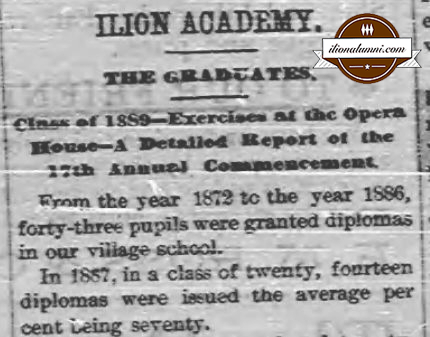
ILION ACADEMY THE GRADUATES Class of 1889 --- Exercises at the Opera House --- A Detailed Report of the 17th Annual Commencement From the year 1872 to the year 1886, forty-three pupils were granted diplomas in our village school. In 1887, in a class of twenty, fourteen diplomas were issued the average per cent being seventy. In 1888, the class numbered twenty-two, nineteen of whom received diplomas, the percentage being eighty-six. The class of 1889 beats the record, out of a class of sixteen, fourteen received diplomas, the percentage 87 1/2 being the highest in the history of the school. This record speaks volumes for the excellent work done by Prof. White and his able assistants. Ilion's school has always borne an excellent reputation both at home and abroad and never did it more deserve the same than at the present time. Prof. White has by untiring industry kept our school up to a high standard of excellency and a more thorough, painstaking principal it would be difficult to find. The Thomas opera house presented a most inviting appearance last evening, having been especially decorated and fitted up for the occasion in most artistic style, and at an early hour every available seat was occupied by Ilion's most intelligent an appreciative people. Over the stage in large letters made of white daisys was the class motto "Wisdom better than wealth" the letters being set on a back ground of evergreen. A profusion of ferns, cut and potted flowers decorated the stage in a pleasing and attractive manner. The music for the occasion was furnished by Cox's orchestra of eleven pieces and added much to the enjoyment of the evening. Seated on the stage were Principal White, the school board, the president and trustees of the village, school commissioner Whitney and our resident clergymen. At a few minutes after eight o'clock Professor White requested Rev. Wm. M. Cook to offer prayer which he did reverently and earnestly. This was followed by the greeting song by the class, whose harmonious and nicely blended voices filled the entire house with melody. Mr. Willis H. Loomis to whom had been granted the honor of giving the salutatory address took up the subject of "Kinetic and potential Energy," which he handled in a philosophical and scholarly manner. Mr. Loomis was particularly clear in his definitions thus rendering what otherwise might have been rather an abstruse line of thought very lucid and intelligible. The student puts himself for years under discipline. This he hopes to use as a guide for his actions through life. This discipline or power of thought as developed by education is potential energy. Kinetic energy is potential energy in motion. The two are so closely combined in use as not be distinguished independently. By their ... effects we are able to estimate the mental capacity and power of a man, and thus read him like an open page. Men are known by their words and by their conduct and they rank according to the refinement of their actions and language, and the originality and usefulness of their deeds. Men of originality are men of genius. Grant was a genius in war and Webster in language. Persons of idle words and of no power ought not to be trusted to represent us. Boastfulness and greatness seldom combine. The study of mankind is a science, but first know yourself. In cases of emergency if one arises and conquers, the world applauds and says the occasion made the man; not so, it is the true man presented through the combined efforts of his Kinetic and Potential energies. Miss Lola E. Briggs favored the audience with an essay on "the Utility and Beauty of Flowers," exhibiting, both in her subject and the method of its treatment more than an ordinary appreciation of the charms of nature as revealed in her crowning work, the flowers. The poetic portions of the essay clearly showed the writers well trained thought and powers of expression.
"The works of God are fair for naught, Miss Brigg's production was read in excellent taste and was well received by her hearers. "In School and Out" was the subject of Mattie M. Green's well written and carefully delivered oration. Our progress in science, increases in wealth, usefulness and happiness in society and fame as a rising nation depends largely upon the training we receive in our public schools. Improve well then your opportunities when in the school room., for success there means success in what ever you may engage in, in the busy world which you are now to form a part. "The Voice of Society" as discussed by Frank M. Golden showed that our relations to society must be such that if we wish success we must set in harmony, in opinions, principles and sentiment with the social organization. The journalist knows that the success of his periodical lies in making it the exponent of the people's views. Society must at all times be consulted and not neglected. Miss Florence A. Myers in her thoughtful essay on "Shams" began by a very happy reference to the classic city of Ilion which the ancient Greeks were only able to conquer by resorting to that famous fraud --- the wooden horse. But shams did not cease with the fall of Ilion. They have come down through tall the ages to these more modern days. The wooden horse of fashion walks abroad, its mysterious recesses concealing evils which only await their time to do their deadly work. Shams are everywhere, in society, in business, in literature, and in art. They ever walk side by side with the real and the true. Let our motto be, "To be rather than to seem." In every relation of life this lies at the basis of all true success. Let character be founded upon truth and sincerity and the structure shall be unmoved by the vicissitudes of life. The next candidate for a share of the good graces of the audience was Miss Kittie D. Steele, with a pleasing oration, "Common Sense", which was filled to overflowing with the desirable commodity of which it so able treater. Common sense has been termed the sixth sense although it might properly rank as first. It is the "application of ordinary wisdom to the affairs of daily life." Its possession leads us to know what we are, and the design of our creation, to know what is to e done and how, when and where to do it, what to expect, and the means to be employed to gain our object. Without this virtue there can exist no real talent nor great genius. The poet, the philosopher, the inventor, and the artist, are each subject to its laws. Upon this common platform meet and stand Watt, Burke, Milton, Goethe and Luther. It is the greatest bond of intellectual sympathy and forms the frame work of social life. He who possesses it in goodly measure is rich indeed. It should be sought after like a precious gem. It you wish to obtain it place a high estimate upon its worth. Properly trained the heart is a trued guide in acquiring it. Common sense makes a study of wisdom in little things sees a harvest in a single grain, a world in a dew drop. It never quarrels with circumstances. It is fully able to practice the art of getting along with people. It commands the present and controls the future. Le us all be rich in common sense. Fred A. Smith truthfully said, "Care" is one of the most important requisites of success. The careful man is always successful. With any honor or responsibility comes care, and that the honor may be well deserved and the responsibility honorably discharged the greatest amount of care is necessary. Negligence is the opposite of care. Mr. Smith made several comparisons in his oration showing how necessary his subject was in all pursuits of life. His effort was an excellent one and the paper showed careful preparation. Miss Gertrude A. Van Namee's essay on "Circles" contained many excellent thoughts and was attentively listened to by the large audience. "Old age cannot encircle the mind. Then outward and still outward let the circle of our lives be carried until its circumference touches infinity." Miss Kate M. Barse chose for the theme of her essay the rather sombre subject of "Solitude," but treated it in so pleasing a manner as to entirely dissipate every suggestion of gloom., bringing prominently into the foreground its more attractive and useful features. This she did in a way which at once commanded and held the attention of the most indifferent listener. Solitude is that condition of the soul in which it freely resigns itself to itself, especially cultivating the powers of thought and of imagination, bringing forth the works of the inventor and the productions of the poet. Had there been no inspiration of solitude there would have been no Milton. Solitude is favorable condition in which to grasp and secure the best thoughts of the mind. Well beaten paths of thought are easy to travel, but when we wish to penetrate beyond the point where our predecessor last his way, we need the strengthening influence of seclusion. Solitude tends to convict the criminal. When he at last finds himself in the utter loneliness of his narrow cell, he for the first time, perhaps, in his life takes a retrospect and is compelled to see himself. "A few so called solitary characters were referred to show the superiority of their accomplishments as Rosseau, Themistocles, Milton, Coleridge, Dante and Byron. Washington and Lincoln were both solitary, especially during the formative period of their character, an din the latter much that we find to admire is, without doubt, due to this fact. Let us not, then, make a gala day of life, but retiring within the sacreds precincts of solitude, study thoughtfully and earnestly the important questions of the hour. "Portia" was the theme of Miss Bessie Ringwood's paper, and the fair Portia received lavish praise at the hands of Miss R., who treated the subject in a masterly manner, finding in Portia "a perfect women, nobly planned to warn, to comfort and to command." A woman to be admired and honored for herself and her intellect. "John Bright: had a noble champion in Chas. I. Rasbach who eloquently portrayed the many virtues possessed by the great English statesman. John Bright exercised great influence in political affairs, whenever he spoke he raised politics from a lower to a higher level. During life an honest hard working man for the public good. In death mourned by the whole English people. Long after such men as Churchill, Hartington and Morely have been forgotten the memory of John Bright will remain fresh, strong and enduring. CLASS HISTORY "Of all the classes since the birth of time praised in story or sung in rhyme. The great class, it has been said of eighty-nine stands at the head." This is what Miss Belle Jennings, the historian of the class, says of the '89 class. Step by step she follows the class thro' their school life relating many little incidents which have occurred in the school room and which are now pleasantly recalled. The politics, religion, and general make up of the sixteen graduates are graphically described and the audience enjoys it all and heartily applauds Miss Jennings when she concludes. CLASS PROPHESCY By Miss Ada L. Cox was one of the most enjoyable features of the program, and as Miss Cox related the future in store for the several members of the class, there was much merriment in the audience. Twenty years hence Miss Cox in rummaging through and old chest runs across her school books and her thoughts are taken back to the class of '89, and in an interesting manner she relates how her school mates are busing themselves on the a stage of life in 1909. She remembers how Miss Inez Baker in the old school days used to dissect flies and make pills and plasters out of dough so it is not to be wondered at that now she writes M. D. after her name and is building up a large practice as a leading physician in one of the important cities of the west. Willis Loomis who was better known as Si, and who always had his lessons well learned and took a good long time to recite them so that the other pupils were not called on, much to their gratification when they were a little rusty in that direction, has become a great man much attached to his books, caring but little for society, and in 1909 the prophetess finds his business card reads, "Prof. Loomis of Harwood University, Ohio." Good looking Charles I. Rasbach is a politician eh, and represents Herkimer county in the assembly and aspires toa seat in the state senate. Attaching Hon. To his name does not puff him up a bit and he is the same fun loving man that he was when a school boy. True, honest, faithful Kittie D. Steele never shirking what seemed to be a duty goes to far away Japan and is doing good work for the Master teaching the poor heathen that old but yet ever new story of Calvary's cross. Miss Libbie Lewis learned stenography and telegraphy, but after a short experience in that line she gives up her employment and becomes the wife of a good, honest farmer in her native town, Schuyler. Fred A. Smith is now a dentist and his shingle adorns a building at 144 Bowery New York city. The screams of his victims (when his is extracting teeth) is something awful to listen to. Miss Gertie Van Namee becomes a very successful school marm, and her scholars regard her as a modern Xanthippe. Miss Belle Jennings is now a fine elocutionist and lecturer, traveling through the country with that congenial lady, Dr. Mary Walker, Miss Jennings doing the oratorical part and supplying dignity to the occasion. Harry VanAlystyne becomes a first-class mechanic and by skill and industry has worked his way up becoming general superintendent of Wyckoff, Seamans & Benedict's typewriter works. Miss Florence Myers is a successful leader of society in New York city, residing on Fifth avenue and is one of the exclusive 400 hundred of which so much has been written. Miss Lola Briggs has no desire to be an old maid and soon filed away the chains which bound her to the state of single blessedness and entered upon the duties of housekeeping which she much enjoys. Frank Golden, the fair prophetess says, always had the gift of gab is it is no wonder we find him traveling about the country as drummer, selling many goods that the house he represents had to build an addition on to their store house each year. Miss Kate Barse is sole proprietress of a ladies bazaar in the flourishing village of Mohawk and is doing a thriving business. Miss Bessie Ringwood excels both in poetry and painting and a volume of her poems are in the Ilion public library while her paintings are admired in both this country and Europe. Here is what Miss Cox has to say about herself, "Hark, there is the bell! It is probably one of those tiresome customers who want to buy a hat for half price with the trimmings thrown in. Oh, of all the detestable lives upon this green footstool, the life of the milliner is the most unbearable. Would I could re-live those days which this book brings to mind when I was a happy member of the class of eighty-nine." Harry E. VanAlstyne orated upon the class motto, ‘Wisdom better than Wealth" and right well did he discuss both the wisdom and wealth side of his subject. In conclusion he said, "Do I wish to lead a life of anxiety and base pleasure and after death leave only reward to that robber who shall steal my bones, I will choose wealth, or do I wish to spend my life in strength and righteousness and leave to posterity gems of truth which shall shine forever, by far more brilliant that the rubies of earth give me knowledge." The class poem by Miss Inez was a very excellent production and reads as follows: CLASS POEM
Now our lessons and tasks are all ended, Oh, those pathways. Where will they lead us? When we think of the paths steep and thorny, To learn the more difficult lessons, We are leaving the school house forever, For the Regent's fiend still pursues them, And we know how it was when to punish, And, oh! How we loved Mathematics! How well I recall our class antics The teachers they surely will miss us, But memoirs sweet we have left them And we leave them that proud class of '90, I am glad that in leaving the school house, But still after all or our trials, As the traveler looks back to the light of home, But wherever we go be it distant or near, Miss Libbie Lewis was awarded the honor of valedictorian and in connection with her valedictory read an essay on "The advice of Robinson Crusoe's father." This advice was that given by a kind loving father to a wayward son who was about to set out alone on the journey of life. It was full of good thoughts and should have been heeded. The same spirit of adventure which filled Robins Crusoe still thrives among many Americans, and as an instance the recent Oklahoma boomers were cited. In closing Miss Lewis said, "to-night we leave our school and teachers to start out on the journey of lie. An untried future is before us and we cannot tell what joys and sorrows it may have in store, but we will try to meet them honestly, bravely and thoughtfully. To the board of education, the teachers, the class of '90 and last her classmates, the fair valedictorian paid a high compliment and closed by wishing them a future in which if there must be a clout it may have a silver lining. On presenting the diplomas to the members of the class, Prof. white addressed the graduates in an able and feeling manner, giving them each and all many sound words of advice and encouragement, and wishing them every success in the life opening before them. The numerous gifts presented to the various members of the graduating class were appropriate and evinced the thoughtfulness and fine taste of the donors. The tableaux were well conceived and added variety and amusement to the evenings entertainment. The guitar duet by Harry E. VanAlystine and Miss E. Belle Jennings brought forth the sweetest strains and was eagerly listened to and heartily applauded. The vocal trio "Like the Lark" by Mr. Chas. I Rasbach and Misses Cox and Baker was a gem in its way and elicited warm applause.

Created and maintained by Aileen Carney Sweeney - Class of 1974
Digital Image Copyright & Copyright © 1997 - 2022 ilionalumni.com
|