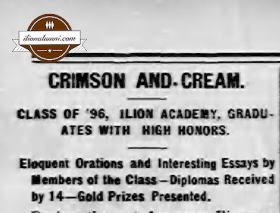
Ilion High School - Class of 1896Ilion Citizen - June 26, 1896Crimson and CreamClass of '96, Ilion Academy, Graduates With High HonorsSource pdf file is here Illion NY Citizen 1896-1898 - 1004.pdf on fultonhistory.com
Crimson and Cream Class of '96, Ilion Academy, Graduates With High Honors Eloquent Orations and Interesting Essays by Members of the Class – Diplomas Received by 14 – Gold Prizes Presented During the past few years Ilion academy has made rapid strides in advancement and now holds the proud position of third among the institutions of its kind in the state: This high rank has been attained through the ability and untiring efforts of its principal Professor J. L. Wood and his competent corps of teachers, the constant care and watchfulness of the Board of Education and the helpful interest always manifested by all our citizens. The village is justly proud of its academy and on Tuesday evening, every seat at the opera house was filled at an early hour by an appreciative and intelligent audience, to witness the graduating exercises of the class of '96. This class, composed of 14 young ladies and gentlemen, ranks very high in attainments, excelling any of its predecessors and having an average standing of 72 per cent. The beautiful stage decorations, largely made up of cut flowers, ferns and palms, were the work of the skillful hands of the class of '97, and testified emphatically to its excellent taste. The class motto, "Conquest Through Labor," in the class colors, crimson and cream, occupied a prominent position and the box fronts were trimmed in the same pleasing colors. Two tables were upon the stage, upon one of which was placed an elegant floral offering, a gift to the class from Mr. and Mrs. O. b. Rudd, while the other was ornamented with the beautiful gold-lined silver class cup, which will be held by the present class until some future one shall capture it by a higher standing. Upon the stage were seated Principal Wood and his corps of teachers, Board of Education, and clergy. Principal Wood presided. Thompson's orchestra of eight pieces discoursed charming music and were down for eight numbers on the program. The selections rendered delighted the large audience, a saxophone solo by the leader, Robert Thompson, being received with marked approval. An opening prayer was offered by Rev. W. C. Taylor. The first speaker was Miss Jessie Skinner, the salutatorian of the class, who delivered her salutatory in a very graceful manner, after which she recited an interesting essay on the "Destruction of Pompeii," giving a vivid description of the destruction of that ancient city. Miss Skinner held the closest attention of the audience and her effort was received with well deserved applause. Charles E. Lewis gave an oration on "The Inventor should monopolize his invention." Among other things, Mr. Lewis said: "Man, very early in his history, became an inventor, but possessing crude taste he was content with simple devices. Gaining in civilization he came to feel the need of better appliances. A true inventor like Edison, must have a keen intellect, close observation, and originality. He makes and perfects his discoveries by his own untiring energy and skill and not by mere chance and will continue to furnish the world with something new and useful. After spending time, labor, and money in perfecting his invention it is only just that the inventor should be protected in its use. The protection afforded by patent incites the inventor to improve what he has already made and to bring out greater and more useful inventions. Why should not the inventor monopolize the product of his own brain? What could become more exclusively his own? Mr. Lewis' production was well written and well received. Miss Carrie M. Baker chose as the subject of her interesting essay, "Room at the top." She remarked that the world is filled with young people and that every calling seems to be full to overflowing. To a young lawyer who complained that the legal profession was overcrowded, Daniel Webster once said, "Young man, there is always room at the top." We should learn to climb. To reach the top of the ladder one must begin at the lowest rung. Heaven is not reached at a single bound. The world contains too many Macawbers. The way to succeed is to make things happen. No man ever reaches higher than he aims, therefore aim high. Miss Baker's appearance was pleasing and her essay given in good voice and manner. "Progress of electricity during the last half century," was the subject of the oration delivered by Harry E. Green. The rapid advancement of the science along practical lines was set forth in a very interesting manner by the speaker. He also referred to what may yet be accomplished in new fields by this great power which promises to revolutionize many of the arts of both peace and war. The preparation of his oration must have cost the speaker no little effort and painstaking research. It was well delivered. Miss Lydia M. Bronner, in her essay on "Dickens' caricature of English schools," showed great familiarity with the works of the famous English novelist, who by pointing out in his writings the shortcomings and abuses of the schools of the island, successfully aroused the English people to demand a radical change in their school system. Miss Bronner's essay was given in a pleasing manner which gained the warm approval of the audience. Ralph W. Gough's oration, which was among the best of the evening, was on "The dangers and benefits of immigration." In the opinion of the speaker the benefits far outweighed the dangers. Without immigration, the progress of the United States would have been decidedly slow. The class poem, read by Miss Ida W. Tefft, proved one of the most enjoyable efforts of the evening. As a writer of verse, Miss Tefft possesses evident marked ability, being, as well, an elocutionist of rare merit. She received generous applause. Alexander F. Armstrong's oration was on "our navy; its strength and weakness." He said the navy excelled in four points – personnel, armament, material and construction. In the latter regard we are especially strong. The number of our vessels is small compared with the extent of our coastline and the number of important cities to be defended. Mr. Armstrong delivered his fine oration in good voice, with easy manner and proper gestures and received warm applause. An excellent essay was read by Marcella M. Foley on "Lessons taught by failure." That her effort was of high literary merit was shown by the fact that Miss Foley proved to be the winner of the cash gold prize offered by the Board of Education for the best essay. Her delivery was very pleasing. She said that some successes were worse than failures. Honest failure, she said, is always better than success gained by deception or dishonesty. Not a few of the world's benefactors have been failures as traders or financiers. Even if we fail to attain our ambition, we may have the consciousness of having done our best. Albert B. Russell, the next speaker, gave a thoughtful and carefully written oration on "Lincoln, as man and president," which he delivered with dignity and excellent effect. His was judged to be the best oration in point of literary merit and was awarded the cash gold prize offered by the Board of Education. Mr. Russell gave a very just estimate of the character, nobility and public services of the immortal martyred President. His effort was heartily applauded. Miss Nellie A. Maury, the class historian, related in a very pleasing way the history of the class as gathered by her from the chronicles of a gramophone. The principal events in the life of the class, both social and literary, was well as a brief description of the prominent characteristics of each member, were given in a manner that evoked unlimited mirth. One of the most finished orations of the evening was that given by the class president, Lee Nelson Caswell, who spoke upon "War versus arbitration," vividly contrasting the horrors of the one with the most beneficent methods and results of the other. Mr. Caswell pictured the outlook for the peaceful settlement of all future international disputes between the leading nations as most probable. The speakers sentiments were warmly applauded by the audience. If Prof. Roentgen, the discoverer of the X rays had been present, he would have been surprised and delighted at the novel way in which the new force in viewing the unseen was utilized by Paul S. Jones, the prophet of the class. By the aid of this subtle agency he was able to portray in a lucid and striking manner, the future destiny of each of his fellow members of the class. His descriptions of what he saw, in his mind, were greatly enjoyed by the audience, much more so than by the victims to which they related. Helen R. McCann held the honor of valedictorian of the class, an honor most worthily bestowed, and chose as her subject, "Conquest Through Labor," the class motto. Lavor, she said, was man's greatest function. Not only achievement, but also happiness, are dependent upon it. When used for wrong ends, the results are disappointing. People who do things easily have little perseverance to overcome obstacles, but strength comes to those who labor to obtain those ends. Miss McCann addressed appropriate words of parting to Principal Wood, teachers, Board of Education, class of '97 and Janitor Powers. The valedictory was gracefully delivered and well received. The class song was finely rendered by the members of the class, after which Principal Wood, in well chosen and appropriate remarks, presented the prizes and diplomas. The benediction was pronounced by Rev. A. C. Loucks, and thus was brought to a very successful close the interesting graduating exercise of the class of '96. The judges to whom the competing orations and essays had been previously submitted and who award the prizes offered by the Board of Education, were Rev. S. C. Taylor, Rev. W. H. Hubbard and James Conkling. All the members of the class received many fine presents from their friends.

Created and maintained by Aileen Carney Sweeney - Class of 1974
Digital Image Copyright & Copyright © 1997 - 2024 ilionalumni.com
|